
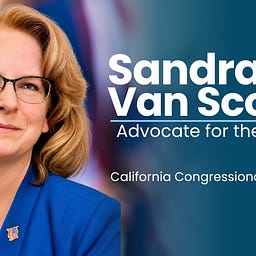
Sandra Van Scotter
September 23, 2026 · Newsletter
Two Seats, One Valley
I have been told to my face that my district is not winnable by a Democrat. I hear this from people who want me to win! So, I want to lay out, with sources, why the question is not whether CA-20 can be won on its own. The question is what happens to the whole southern Central Valley if it is not.
Four cities, cut in half
Let’s start with the map. The congressional districts California adopted under Proposition 50 take effect when the next Congress is seated on January 3, 2027. Under those new boundaries, CA-20 wraps around CA-22. Four cities are divided between the two districts. The UC Berkeley Statewide Database has the exact numbers: Bakersfield is split 178,226 to 226,935. Hanford is split 39,596 to 18,746. Porterville is split 32,501 to 30,405. Tulare is split 36,538 to 32,662.
That means Kern Medical, the public hospital in Bakersfield, has two members of Congress. So does the county office on East California Avenue that will process Medi-Cal redeterminations. So does the water district in Porterville, the city hall in Hanford, and the hospital in Tulare that no longer delivers babies. Whatever happens to those places happens in both districts at once.
Who lives here
The three counties both districts share, Kern, Kings, and Tulare, are home to about 1.55 million people. As of January 2026, 827,600 of them were enrolled in Medi-Cal, which is 53 percent of everyone and 71 percent of the children. In Tulare County it is 58.5 percent of the whole population and three of every four kids. In Kern it is 52.3 percent. In Kings it is 43 percent.
As of December 2025, 236,060 residents of the three counties received Social Security: 171,060 retired workers, 23,760 disabled workers, and the rest spouses, children, and survivors. Social Security pays about $380 million a month into these three counties, roughly $4.6 billion a year. About 182,000 of those beneficiaries are 65 or older, which sets a floor for the number of Medicare enrollees here.
Put the two programs together and well over half the people in these counties depend on a federal health program, a federal retirement check, or both just to live and survive. Whoever holds these two seats represents them.
On water, they sign together
We did the research on how the current representation actually behaves: On agricultural water, the two Republicans who represent these districts today work as a team, and they work with the Valley Democrats too.
In March, the Department of the Interior announced $540 million for California water projects out of the reconciliation bill’s Reclamation fund, including $200 million for the Friant-Kern Canal, which has sunk from groundwater pumping. Rep. Fong announced it. Friant Water Authority credited Rep. Valadao, Rep. Fong, and the whole California delegation. The Lower Tule River Irrigation District thanked both members for $14.6 million to enlarge Success Reservoir above Porterville. This is what representatives of a shared geography do when the issue is a canal. They would keep doing it with a Democrat in CA-22.
On hospitals, they split
Now the safety net: On April 14, 2025, twelve House Republicans wrote to their leadership saying they would not support a reconciliation bill that reduced Medicaid coverage for vulnerable people. David Valadao is the first signature on that letter. Vince Fong’s name is not on it.
Both of them then voted for the bill. CalMatters called Valadao’s the decisive vote and reported that 64 percent of his current district is on Medi-Cal, the highest share of any Republican-held seat in the country.
What did they do next? In January, they jointly hosted CMS Administrator Oz at Kern Medical to talk about implementing the law. In June, Fong announced CMS had approved California’s hospital fee program, calling it a $5.9 billion net benefit for hospitals, and the release quotes Kern Medical’s CEO thanking him. Meanwhile Rep. Costa, the Valley Democrat to the north, held his own roundtable and said plainly that the new rural health fund is not sufficient to offset the reductions.
So, the two members who share Bakersfield voted for the cut, and then spent this year managing it. Neither has asked Congress to reverse any of it.
Kern County put a number on it
One county they both represent did the math. On March 25, 2026, the Kern County Board of Supervisors wrote to Governor Newsom. The letter says California’s counties will face six to nine and a half billion dollars a year in new costs when the law is fully in effect: care for roughly 417,000 people expected to lose Medi-Cal and land on county indigent programs, a $2.3 billion annual cut in state payments to public hospital systems like Kern Medical, and about 2,000 additional eligibility workers statewide to process the paperwork. It asks the state for $1.9 billion next year and $4.5 billion the year after.
Read the distribution list. The letter went to the Governor, the Department of Finance, the state health agency, Kern’s state legislators, and the counties’ association. Not one member of Congress was sent a letter.
Read the county’s own 2026 legislative platform, adopted four months after the law was signed. It says the county opposes federal cost shifts and supports funding for hospitals that serve the uninsured. It never names the law. Its only federal earmark requests to Fong and Valadao are $3 million for pavement at a recreation area and $500,000 for communications vehicles. The county knows what the vote will cost. Kern County did not think it was worth asking Washington to fix it.
What January looks like
The Medi-Cal work requirement begins in January 2027. Every adult in the expansion group will have to document 80 hours a month of work, school, or service at their next renewal and then every six months. DHCS estimates 4.8 million Californians are in the group subject to the rule and 1.1 million will lose coverage by 2029. Before that, on October 1, the law narrows eligibility for certain lawfully present immigrants; the Legislative Analyst’s Office expects 200,000 people to lose Medi-Cal from that change alone. Kern County’s letter expects people who lose coverage to start showing up at county clinics and emergency rooms by spring.
The county offices that will handle this are the pinch point. The Legislative Analyst’s Office found that the state’s formula for funding county eligibility staff lacks a clear link to workload at the moment the workload is about to double for processing 4.9 million people. In Kern, the Shafter office is running out of the child welfare building with limited staff and no walk-in interviews. Tulare and Kings counties have published nothing about their own office capacity that I could find. That silence is not reassurance.
And the hospitals were thin before any of this. Adventist Health Tulare closed its obstetrics department in June 2024, and in fact stopped delivering five weeks early. A city of 69,000 people, split between two members of Congress, has no place to give birth. Ridgecrest Regional Hospital suspended labor and delivery in March 2024 after subsidizing it at about $5 million a year; it reopened that December only because the Navy signed a standby medical services contract under its emergency expense authority so that China Lake families would have a hospital. A Navy admiral called the lack of local care an existential threat to the workforce. That is the federal government rescuing one hospital in one town, because a weapons base needed it. Tehachapi and Lake Isabella got no such rescue.
Why one seat is not enough
Fast forward to January 2027. Randy Villegas has won CA-22. He wants Congress to revisit the Medi-Cal cuts, or restore the hospital payments, or fund the county workers Kern County’s letter asked for. He needs the delegation. He turns to the member who represents the other half of Bakersfield, the other half of Hanford, the other half of Porterville, the other half of Tulare. And that member is on record voting for H.R. 1 and calling its hospital fix a win.
One Valley Democrat alone cannot change that. Two can! On water, the Valley already votes as a region and will keep doing so. On healthcare, the region has no voice in Congress asking for anything but implementation, and the counties that share both districts have not asked Washington at all.
That is why CA-20 is not just a courtesy candidacy. It is the seat that makes the other seat work. If Randy wins and CA-20 is NOT flipped, the map of Central Valley representation on the issue that voters raise first at every door looks essentially the same as it does today.
My first ask: vote, vote, vote
Ballots arrive starting October 5. Get yours to a drop box the week it arrives. Then find five people in Bakersfield, Hanford, Porterville, Tulare, Ridgecrest, Lemoore, or anywhere in these two districts, and tell them the same thing. Every document linked in this essay is public. Read them yourself. Then decide whether the southern Central Valley can afford to send only one voice to Washington on healthcare, or needs two.
Two seats. One Valley.
Paid for by Sandra Van Scotter for Congress