
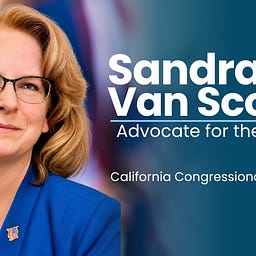
Sandra Van Scotter
August 10, 2026 · Newsletter
The Potentially Catastrophic Health Care Rule We Almost Missed
It is already in effect. It could put sick people in debt just to be able to access their own health care coverage. And you will start choosing from these plans two days after you vote. Here is what happened, and why it matters right now.
I spent thirty years as a respiratory therapist and an advocate for disabled adults. A lot of that work was standing at a bedside at two in the morning, translating something frightening and complicated into plain words for a person who needed to understand it “right now.” That is the same job I am doing here.
There is a federal health care rule that runs 352 pages. Almost no one outside the insurance industry read it. It is already in effect, and it quietly changes what health insurance means for families in Kern, Kings, Tulare, and Fresno counties. I read it so you have someone to bring your questions to when you have time to read it. Here is what I found in it, how it slipped past us, and why you need to know before November.
How did we almost miss this?
The rule has one of the most boring names in government: the HHS Notice of Benefit and Payment Parameters for 2027. It sounds like accounting. That is part of how these things pass without a headline.
The public was given a short thirty-day window to comment, and barely anyone outside the insurance industry used it. Insurers and brokers filed detailed comments. Patients, doctors, and families mostly never knew it was happening. The rule was then finalized later in the calendar than any payment rule in this program’s history, and it took effect this summer, with the changes hitting plans that start on January 1, 2027.
And the single most alarming idea in it is one sentence. On page 29,687, the government suggests that insurers could offer to loan you the money for your deductible. The word “financing” appears exactly once in all 352 pages. One sentence, no rules attached, buried in hundreds of pages of actuarial detail. This was not missed by accident. It was buried in plain sight.
What the rule actually does
To understand why that one sentence matters, you have to understand what these plans are.
A catastrophic plan has a low monthly premium, which is what makes it look attractive. But it covers almost nothing until you pay an enormous deductible. Before that, you get preventive care and a few primary care visits a year. Everything else, you pay in full until the enormous deductible is paid. And in these plans, the deductible and the out-of-pocket maximum are essentially the same number. The cap is not a safety net waiting for you at the end. It is the price of admission, before the coverage does anything at all.
The rule does several things at once. It opens these plans to far more people, including many who simply make too much to receive subsidies. It lets bronze plan deductibles climb as high as $15,600 for an individual and $31,200 for a family in 2027, and it lets catastrophic plans have even higher deductibles in 2028. It lets these plans lock in for as long as ten consecutive years.
Now back to that one sentence. The government floated the idea that when you cannot afford your deductible, your insurer could simply lend you the money. No insurance company actually offers this to consumers yet, so this is a door the rule opens, not a product on the shelf today. But think about where it points. Your insurance company becomes your bank. You pay interest to access your own medical care. And the government wrote hundreds of pages and could not spare a single paragraph to put a guardrail on that idea.
I want to be precise about one thing: the ten-year term might be described as a trap that locks the insured in. That is not quite right, and the truth is worse. The ten-year term binds the insurer to cover you, not to force you to stay. You can still leave at open enrollment, or when your life changes. But if you borrowed to cover a deductible, that debt follows you out the door. The trap is not the contract. It is the money you owe (if you took a loan to pay the deductible), and the fact that as premiums keep rising across plans, there may be nowhere less expensive to go.
To be clear: this rule applies to coverage you buy for yourself on the Affordable Care Act Marketplace. It does not touch the group health plans most people get through a job, so if your insurance comes through an employer’s group plan, none of this applies to you. The exception worth noting, because it is becoming more common among smaller employers, is when a company drops its group plan and instead hands workers a fixed allowance to buy their own coverage through Covered California, an arrangement called an individual coverage health reimbursement arrangement (ICHRA). Those workers are back in the individual Marketplace, so this rule applies to them, deductible and all.
Where the squeeze comes in
None of this happened in a vacuum, and this is the part that ought to make you angry.
At the end of 2025, the enhanced tax credits that had kept marketplace premiums affordable were allowed to expire. Premiums jumped. On average, people paid 58 percent more out of pocket for their premiums in 2026. More than a million fewer people signed up than the year before, and of those who did, many could not hold onto the coverage. By February 2026, the number of people actually enrolled had fallen from 22.1 million to 19.2 million, a loss of nearly 3 million and the steepest single-year drop since the marketplaces opened. The administration credits its own fraud crackdown for part of that, but independent analysts say the expired tax credits explain most of it, and they project the full-year loss could approach 5 million. And right on cue, the low-premium financially catastrophic plan starts to look like a lifeline.
Here is the part to remember: catastrophic plans cannot be bought with tax credits. They never could. So they only begin to look affordable once the subsidized plans, the good plans, get even more expensive. The government’s own paperwork justified expanding these bare-bones plans by pointing to the very premium spike that letting the credits die had caused. It is two halves of the same squeeze. Let the affordable option lapse, then offer the unaffordable one dressed up as the answer.
Independent researchers found that keeping those tax credits would have helped families by hundreds of dollars a month more than these catastrophic plans ever will. We were handed the worse deal. It is the middle class that gets squeezed hardest. Families earning a little too much to utilize tax credit help are now staring at premiums they cannot afford.
Sacramento is fighting for us. The current US Representative is not.
Here is what makes this especially hard to stomach. California saw this coming, and has already been fighting it.
Years ago the state banned medical providers from signing patients up for deferred-interest credit cards, the zero percent offers that quietly turn into high interest the moment you fall behind (SB 639). Last year it banned medical debt from credit reports, a law sponsored by our own attorney general and the California Nurses Association (SB 1061). And when this federal rule was proposed, Attorney General Bonta co-led a coalition of 19 attorneys general who told Washington in writing to kill it.
California’s own marketplace agency put the same objection on the federal record. In a March 2026 comment letter to CMS, Covered California’s executive director, Jessica Altman, urged the government to withdraw the higher deductibles and the ten-year plans outright, and to leave catastrophic eligibility for the states to decide. She called the deductible increase “clearly contrary” to what the Affordable Care Act requires, warned it could leave some people paying “nearly half of their annual income” before their coverage pays for anything, and said it would “significantly increase medical debt.”
A loan from your insurer to cover your deductible is a new kind of predator. California’s medical-debt protections were built for debt owed to providers and for the credit cards pushed in doctors’ offices, so an insurer acting as your lender may slip through the gap between them. A state lawmaker moved to close part of that gap this year with AB 2746, a bill to treat CareCredit-style medical credit card debt like other medical debt and keep it off your credit report. But the financial industry lined up against it, the California Bankers Association, the Card Coalition, and the rest, and the bill stalled in committee this spring.
Sacramento is doing everything a state can do. But even California’s strongest laws may not reach a plan the federal government authorized, and no bill passed in Sacramento can cast a vote in Congress. The one person with a vote in Congress, the same person who is supposed to represent the people in Fresno, Kern, Kings, and Tulare counties, has not even acknowledged this catastrophe is coming.
Why this matters right now
Here is why I am writing this now and not in January.
Open enrollment for these plans opens on November 1. Election Day is November 3. You will start choosing your 2027 health plan two days after you cast your vote, with a low premium waving at you and an obscenely high deductible you hope you won’t need to pay.
These plans take effect on January 1, 2027. The new Congress is sworn in on January 3. Whoever wins the seat that represents our district gets swarn in while this goes live, and serves through 2028, when parts of it are designed to get even worse.
Here is the part that matters most: this rule took effect without a single vote. No one in Congress had to lift a hand for it to become reality. But every move to reverse it runs through Congress. Repealing it takes a vote. Restoring a real cap on deductibles takes a vote. Bringing back the tax credits that kept your premiums down takes a vote, and the House already passed that extension this year, only to watch it stall in the Senate. The damage is automatic. The reversal is an act of Congress. That is the job I am running for. And if anyone tells you Washington is already handling this, note that the bill they are pointing to, the Great American Healthcare Plan (H.R. 8324), does not touch this rule at all. It answers sky-high deductibles by offering people a way to save to pay them, not by making them more affordable.
What you can do now
Before you click enroll on any plan this fall, ask one question: what is the deductible, and does this plan pay for anything before I have spent thousands of dollars out of my own pocket? If the answer is that you are on the hook for the first fifteen thousand dollars or more, you deserve to know that before you choose, not after.
I also went looking for any warning about this rule from the congressman who currently holds the CA-20 seat, Vince Fong. I could not find one. If he has spoken up about it, I will gladly correct the record. But I am not willing to let the people I want to represent walk into this blind.
That is why I am telling you now. Read all the plan options thoroughly. Ask the deductible question. Share this article with someone who buys their own insurance. And in November, remember that the person representing Kern, Kings, Tulare, and Fresno counties in Washington, D.C., is one of the votes that decides whether this gets fixed, or gets worse.
I spent my career helping people breathe. I am not going to stay quiet while Washington makes it harder for us to afford to.
Donating to my campaign helps us continue to being you great content like this. Please consider donating at:
https://secure.actblue.com/donate/sandra-van-scotter-ca-20
Paid for by Sandra Van Scotter For Congress