
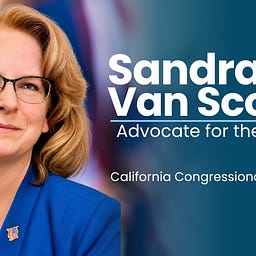
Sandra Van Scotter
June 5, 2026 · Newsletter
Let's talk about money in politics and how individual donors were never part of the equation, until now.
Last week I did something nearly every candidate eventually does. I sat down with a phone and a list of registered voters and I called them, one by one, to ask for money. They call it “call time.” It is widely understood and accepted to be a “rite of passage” for almost everyone running for public office. I understood it that way too, up until I tallied the result.
Lots of great conversations. Zero donation commitments.
Thanks for reading Sandra's Substack! Subscribe for free to receive new posts and support my work.
This was my very first time participating in this “call time” process. I wondered if I was “bad” at this, because the quality of the conversations did not translate to donations. Then I wondered if the people I was reaching are apathetic or just ready for this election cycle to be over. Do they not care enough to chip in twenty-five dollars for something they say they care about? And then, sitting there with a cold list and zero commitments, I could physically feel the logic that pulls candidates toward PAC money and organized interest groups. A PAC doesn’t make you sweat through hundreds of “no thank yous.” A PAC writes one check. The attraction is arithmetic.
So, being the forever-student I am, I wanted to know if the political campaign fundraising process ever included individual small-dollar donors. Was there a time when the average citizen stopped funding campaigns and let the “big money” take over? So I went looking….
I found three answers — a history, a psychology, and a trap. We did not abandon a system we used to fund. The reason our anger at money in politics hasn’t turned into action isn’t apathy. And the anger itself is being quietly turned against us. Every one of these answers points to an inaccuracy the “money in politics” situation tells us about ourselves. Let me show you why.
Part One: The history — we didn’t leave, because we were never in the room
My search into the answers to my questions led me to a history lesson. I initially thought ordinary people used to chip in to fund their preferred candidates, their dollars got drowned out by bigger donors, they gave up in disgust, and PACs rushed into the vacuum the citizens left behind. The story I told myself casts us as the betrayed donors who walked away.
I went looking for the evidence to support my hypothesis. It isn’t there. The real history runs differently, with a few twists.
Before the campaign-finance reforms of the 1970s, federal elections ran on party machines and wealthy individuals — not fueled by small-donor public contributions. The reason is simple: until those reforms, money from business interests could enter elections in essentially unlimited amounts, as large contributions from wealthy people tied to corporations. Nobody needed to pool $25 checks from a mass public when a handful of “fat cats” could fund the whole thing. The participatory, citizen-funded golden age I thought I would find never existed.
Even the first political action committee (PAC) wasn’t a corporate scheme — it was a labor union. The CIO-PAC, formed in July 1943, helped re-elect Franklin Roosevelt after Congress barred unions from giving directly to candidates. Unable to spend treasury money, the union pooled small voluntary contributions from individual members. Note: the very mechanism that overshadows the modern day small-dollar individual donor began its life as a way to organize small-dollar individual donors.
Then came more irony: After Watergate, Congress passed the Federal Election Campaign Act — enacted in 1971, amended in 1974 and 1976 — to clean up big money in politics by capping direct contributions to candidates. But capping the money didn’t make it vanish. It made the money look for a new container, and the container was the PAC. In 1975, the Federal Election Commission’s SunPAC opinion (AO 1975-23 opened the door for corporations to run PACs the way unions had. The FEC’s own records show what followed: there were 608 PACs at the end of 1974, and more than 4,100 by the early 1990s. And the growth never stopped. After the Supreme Court’s Citizens United decision in 2010 opened the door to Super PACs and hybrid PACs — categories that didn’t even exist in those earlier counts — the number climbed again: in the most recent full election cycle, roughly 8,970 federal PACs reported activity to the FEC through September 2024. (One honest note: the older figure counts committees registered, while the newer one counts committees that reported financial activity, so they aren’t measured in precisely the same way — but both are the FEC’s own numbers, and the trajectory is unmistakable.) From 608 to nearly nine thousand PACs. Reformers trying to push big money out of politics had accidentally handed money in politics a faster delivery truck — and tilted the field toward the organized interest groups with the most corporations to sponsor those PACs.
So when did the small-dollar donor arrive? Relatively recently. Mass small-dollar giving came with the internet. The share of Americans who say they donated to a candidate doubled from 6% in 1992 to 12% in 2016. Decades of FEC data show small donors only began outpacing larger donors around 2008, and small-dollar fundraising climbed to a record peak around the 2020 cycle. The small-donor movement isn’t a return to a lost ideal. It’s a recent invention — young, and not yet established.
So here is the first thing individuals did not break: we did not walk out of a system we used to fund. There was no participatory past for “big money” to steal from us. We can’t abandon a room we were never invited into. The small-dollar individual donor isn’t the relic in this story — the small-dollar donor is the brand-new arrival.
Part Two: The psychology — our silence isn’t apathy, it’s arithmetic
Fine, you might say — but people are furious about money in politics. So why hasn’t that anger become a wave of small, individual donations? Why don’t the millions of people simply take over the political funding and fundraising process?
This has a deep, well-established answer, and it has a name: the collective action problem.
In 1965, the economist Mancur Olson published The Logic of Collective Action, and his core finding explains the zero donation commitment I ended my “call time” session with. Large groups with diffuse interests struggle to organize, while small groups with concentrated interests dominate — because in a big group, each person rationally figures their single contribution won’t change the outcome, so they hold back and let others carry the cost.
A civics textbook puts the mechanism plainly: there’s a disincentive to call your member of Congress, because one call rarely sways a politician. The same logic governs our checkbooks. An oil company has an intense, focused, dollar-quantifiable stake in a single vote, so it organizes and gives. Each of us, as one of three-quarters of a million constituents in this Congressional District, has a stake that’s just as real but diffuse — and the nagging sense that our $50 is a drop in the ocean of a candidate’s financial need. Multiply that feeling across a hundred million angry people and we get exactly what we see: enormous aggregate anger, almost no aggregate donating. Expressing anger is easy; donating is costly. So anger flows most easily into the cheap forms of participation — a vote, a poll response, an angry social media post — and only rarely clears the higher bar of the wallet in the form of a donation to a candidate promising to make a difference.
And here is what completes the picture: even the waves that did happen never actually took over. Obama, Sanders, Ocasio-Cortez — those were real small-donor surges. But even at the high-water mark, big money still overwhelmed small-dollar donations. Obama’s celebrated small-donor machine still drew most of its money from large donors; his under-$250 gifts were only about 34% of his 2012 total. The waves crested around charismatic candidates and their moments, then receded, because the underlying math never changed.
So here is the second thing we have no control over: when we didn’t give, we weren’t being lazy or indifferent. We were doing the rational thing that nearly every member of a very large group does. Our silence is a predictable feature of a sixty-year-old law of human behavior — not a verdict on our (individual) character. The organized interests who “took over” the process did so precisely because they were few, with concentrated stakes. We are many, with the same diffuse stake. That’s the whole asymmetry, in a sentence.
Part Three: The trap — our anger is being turned against us
There’s a more cruel layer underneath the arithmetic, and it’s the one that should make us angriest — because it turns our own fury into a reason not to take over the processes that appear to silence us.
Political scientists measure something called external efficacy: your belief that government actually listens and responds to people like you.
It’s one of the strongest known predictors of whether a person participates at all. And a 2024 study in Social Science Quarterly found that, across three surveys of nearly 2,800 Americans, attitudes about money in politics were the single strongest predictor of external efficacy among every factor tested — stronger than party, age, income, or political knowledge (standardized effects of roughly 0.24 to 0.32, all highly significant). The direction is the gut-punch: the more strongly someone believes money dominates politics, the less they believe government responds to them — and it held for Democrats and Republicans alike.
I need to point out: that’s a correlation, not proof of cause, and even this strongest-of-all factor leaves most of what shapes the feeling unexplained — the authors are candid that the drivers of efficacy aren’t well understood. But the association is strong, consistent, and party-blind.
And the feeling isn’t based on anecdotes — it’s measured and well-researched. The same researchers note that members of Congress who take more money from outside their districts are measurably less responsive to the constituents inside them. Step back and the scale is staggering: a dozen individuals supplied about $3.4 billion — roughly 7.5% of all political giving — between 2009 and 2020. When you suspect the system answers to a handful of large donors instead of to all of us as individuals, we are not imagining things.
Now watch the loop close: Believing the system answers to big money makes us feel unheard. Feeling unheard makes us withdraw — and research on participation finds that low efficacy suppresses the very kinds of participation, including giving, that might push back. Our withdrawal leads to the small-dollar vacuum. The vacuum lets big money in politics grow louder. And big money growing louder confirms the original feeling. The anger that should fund the alternative instead drains our “participation” tanks — a perfect, self-sealing trap. And we didn’t build it.
So here is the third thing I learned: our anger isn’t hypocrisy, and our silence isn’t weakness. We are responding sanely to a true signal — from a system engineered to make our dollars feel like they don’t matter. The cause isn’t on us for receiving that signal. It’s in the machine that sends it — a machine built over decades out of reform legislation, regulatory rulings, and court decisions, and populated by the organized interest groups that learned to work within it.
What we should actually be angry about — and what we can do about it
Let me separate two things that usually travel together, because keeping them tangled is what wears people out.
The anger is legitimate. The system genuinely is built so that concentrated, organized money speaks louder than an individual voter-donor — and that’s true whether or not we ever wrote a check. The imbalance is real, and worth being angry about.
The individuals did not cause this imbalance. We didn’t break this. We didn’t desert a system we initially funded, because there was never a citizen-funded system to desert. We didn’t fail to rise up out of apathy — we responded, like everyone in a large diffuse group, to arithmetic that makes individual action feel pointless. And when we pulled back from the signals we were receiving, we weren’t failing a test of character — we were reacting to a real signal that indicates the system answers to money, not to us.
Here’s why that matters beyond making us feel better. If the small-donor era were something we lost, fixing it would mean turning back a clock we can’t turn back. But if it’s something we’re only now building — for the first time, with new tools — then it isn’t a restoration project, it’s a construction project. And construction is a choice we make in the present to change our future.
There’s an antidote to that trap, and it isn’t “feel better about money in politics.” The researchers who documented the efficacy collapse are blunt that the fix can’t be asking people to like big money more — they call that inverse argument absurd.
The fix is the real thing the feeling is reaching for: demonstrated responsiveness. And efficacy responds to exactly that — a 2026 study found that direct, face-to-face contact with policymakers measurably raised people’s sense that government listens, but only for those who actually engaged, not those who watched from the back. Being heard, concretely, by someone who answers — that is what rebuilds the belief that showing up is worth it.
Olson didn’t only diagnose the problem. He described how groups of individuals overcome it: through organization, and by making each person’s contribution feel visible and consequential instead of lost in the ocean of political financial need. That is, almost word for word, what works in small-dollar politics today — the moment that makes a gift feel urgent, the ask from someone we actually know, the running tally that shows where our $25 donation was actually used. None of it changes the “law of large groups.” All of it changes how it feels to be one person inside a large group.
Why I still won’t take a dime of PAC money
I came out of that zero-donations call-time session understanding the temptation toward PAC money better than ever — and more committed to refusing it.
Because the dollar from an organized interest group and the dollar from a human being who decided the candidate is worth twenty-five dollars are not the same dollar, and they never were. The whole apparatus exists because organized money is more efficient than persuaded individuals. But that efficiency carries a structural cost: money raised through any organization — a corporate PAC or a union PAC, whatever its intentions — ties a share of a candidate’s accountability to that organization, rather than directly to the individual people back home. Plenty of candidates take union money in good faith, believing the union speaks for the many — and they may well be right. My choice is simply to keep the line direct: every dollar is from people I answer to, with no organization in between.
The actual human donor — the person who has to be convinced, who gives because they believe something will change — is not the weak link in this system.
That person is the entire point of representative government.
So no PACs. Raising real money without PACs is swimming upstream, since the entire current of modern campaign finance runs the other way, toward the organized money that’s faster to raise and the norm nearly every campaign now expects and accepts.
A campaign funded by the many — one individual at a time — answers to the many. And I want that accountability built in from the first dollar, not promised after the fact.
Raising money from individuals isn’t a guaranteed rising tide. In 2024, small-dollar giving showed real strain: the share of President Trump’s individual fundraising from donors giving $200 or less fell from about 52% in 2020 to under a third, and his small-dollar total dropped roughly 40%, even as Democratic small-dollar giving held strong. The tide can go out. That isn’t a reason for despair — it’s the reason the word frontier fits this better than the word trend.
The small-dollar donor isn’t a relic. The small-dollar donor is the frontier of campaign finance. And frontiers belong to whoever decides to show up — not because any one of them tips the balance, but because deciding to show up is how a diffuse, angry, exhausted majority stops waiting for someone else to go first.
It’s time for individual donors to walk into the room so we can take control of money in politics.
With gratitude,
Sandra
Please consider giving to my campaign at linktr.ee/SandraforCongress.
If a link ever fails, write to me and I’ll send the underlying document.
Sources
✅ Federal Election Commission, semi-annual PAC counts, 1974–2000
✅ Federal Election Commission, Statistical Summary of 21-Month Campaign Activity of the 2023–2024 Election Cycle (current PAC count)
✅ Federal Election Commission, SunPAC advisory opinion / IAM v. FEC
✅ Oxford University Press, The Rise of Political Action Committees (CIO-PAC founding)
✅ Mancur Olson, The Logic of Collective Action: Public Goods and the Theory of Groups (Harvard University Press, 1965) — foundational scholarly text
✅ Texas higher-education OER, American Government: Collective Action and Interest Group Formation
✅ Katherine Haenschen, “The normatively troubling impact of attitudes toward the role of money in politics on external political efficacy,” Social Science Quarterly 105(3), 2024
✅ Journal of Youth and Adolescence, reciprocal relationship between participation and political efficacy (2025)
✅ Frontiers in Political Science, citizen participation and political efficacy: a town hall study (2026)
⚠️ Pew Research Center, 5 facts about U.S. political donations (drawing on ✅ American National Election Studies)
⚠️ American Enterprise Institute, The Business PAC Phenomenon: An Irony of Electoral Reform
⚠️ Bipartisan Policy Center, Trends in Campaign Financing, 1980–2016
⚠️ OpenSecrets, What Is a PAC?
⚠️ Encyclopædia Britannica, Federal Election Campaign Act
⚠️ Encyclopedia.com, Free Rider (summarizing Olson)
⚠️ Washington Post, on the decline of public campaign funding (Obama 2012 small-donor share; hosted on Rep. Cole’s House.gov page)
⚠️ PBS NewsHour, Trump’s small-dollar contributions have plummeted since his last campaign (AP/OpenSecrets analysis of FEC data, 2024 cycle)
Paid for by Sandra Van Scotter for Congress.
Thanks for reading Sandra's Substack! Subscribe for free to receive new posts and support my work.