
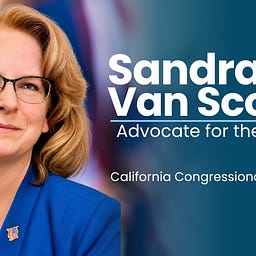
Sandra Van Scotter
May 31, 2026 · Newsletter
Let's talk about those $1,000 Trump "baby" Accounts
First — thank you. To every family who has written to me or stopped me to ask about this, thank you for asking before you signed up for anything. You saw the headline — the government will put $1,000 in an account for your baby — and instead of just taking it or dismissing it, you asked questions. If it sounds too good to be true, it probably is; and it’s the whole reason I’m writing this.
So let’s clarify what this account actually is — because even my own Congressperson is promoting this as something it is not.
The “Trump Account” is not a gift. It’s not college money. It’s not something you can spend on your child (at least not for eighteen years, and even then, not without a cost). It’s a retirement account — a traditional IRA — opened in your child’s name, with one $1,000 deposit from the U.S. Treasury, created under the One Big Beautiful Bill Act (Public Law 119-21, signed July 4, 2025). That’s the entire government contribution. One time. Everything after that is up to you.
I spent twenty years as a respiratory therapist, and a lot of that work was sitting with families and translating complicated rules — what the insurance covered, what it didn’t, and why the form said one thing while the reality said another. My current full time job is to explain this type of stuff to disabled people and their families. Same conversations, two different audiences. Here is what you need to know to make an informed decision.
What’s true — and the part that sounds good
A child born between 2025 and 2028, who is a U.S. citizen with a Social Security number, can receive a one-time $1,000 Treasury deposit. You file IRS Form 4547 (or use the portal at trumpaccounts.gov), and contributions can begin July 4, 2026. Families, employers, and charities can add up to $5,000 a year. The money grows tax-deferred, invested in a low-cost U.S. stock index fund.
And here’s a distinction the headlines blur, so let me be precise about it: the $1,000 is not for any child under 18. You can open a Trump Account for almost any child under 18 with a Social Security number — but the government’s $1,000 only goes to children born between January 1, 2025 and December 31, 2028. If your child was born before 2025, you can still open the account, but the government puts in nothing — you’d be funding an empty, locked, taxable IRA entirely yourself. So for most children already living in our district, the “$1,000 for your baby” promise delivers exactly zero dollars.
If you have $5,000 a year to spare and you’re thinking decades ahead, I understand the appeal. The following is what comes with opening this account.
The part that worries me
It’s locked — and then it’s penalized. No withdrawals before your child turns 18, not even for a hardship. After 18 it becomes an ordinary IRA, and taking money out before age 59½ generally triggers a 10% penalty. So a family imagining this as a fund for a first car, a first apartment, or tuition is going to meet taxes and penalties they never saw in the headline.
The tax is worse than the alternatives. When the money finally comes out, the $1,000 seed — and all the growth on it — is taxed as ordinary income. Only the after-tax dollars your family put in come back tax-free. Compare that to a 529 plan (where money spent on education comes out completely tax-free) or a Roth IRA. The Trump Account’s earnings never escape tax. The “free” $1,000 is taxable on the way out.
Somebody has to keep the records for eighteen years. The account mixes pre-tax money (the government’s $1,000, any employer or nonprofit contribution dollars) with after-tax money (what your family contributes). If no one tracks which is which over those years, your child can end up taxed twice on the same dollars — the money your family already paid taxes on before you contributed to this account.
The part I will not let any family miss
I’m a Disability Community Advocate, and here is where I need you to really pay attention:
If your child becomes disabled, this account can actively hurt them.
Here’s why. A Trump Account is a countable asset — and the child is the actual owner of this account. Supplemental Security Income (SSI) has a resource limit of $2,000, a number that has not been raised since 1989. A Trump Account that grows past that limit can disqualify a disabled child from SSI — and in most states, losing SSI means losing the Medicaid that comes with it.
That’s the exact opposite of how the tools built for disabled people are supposed to work. An ABLE account is designed to be invisible to those tests (up to $100,000 in an ABLE account doesn’t count against the SSI limit). A Special Needs Trust does the same job another way. A Trump Account does neither — it sits right on top of the resource limit and counts against your child.
Congress did build one way out — and I’d gently point out that the ‘out’ is so narrow most families will never hear about it in time. You can roll a Trump Account into an ABLE account, but only during the one calendar year your child turns 17 — not before, not after. It has to be a direct trustee-to-trustee transfer. Think about what that means. If your child becomes disabled at 3, you’re holding a countable asset that can cost them SSI and Medicaid for the next fourteen years, with no way to move it until that single year arrives. And if your child becomes disabled at 18 or later, the window has already closed for good — the money is stuck in a countable IRA with no clean way out. Nothing in the sign-up process warns you. Nothing flags the rollover year. You simply have to already know.
And the question no parent wants to ask
Someone asked me what happens to the account if a child dies before turning 18. It’s the most difficult question a parent can ask — and the families I care for taught me that you answer difficult questions directly. There is no talking around them.
Under the IRS guidance (Notice 2025-68, Q&A E-4, carrying out section 530A(d)(6) of the law), if a child dies before 18, the account stops being a Trump Account — and stops being an IRA — as of the date of death. It’s treated as though everything was cashed out that day. The $1,000 and all the growth are taxable as ordinary income. There’s no early-withdrawal penalty in that case — a small mercy. But there is a tax bill. And if no beneficiary was ever named on the account, that bill is reported on the child’s own final tax return, and the money passes through their estate.
I want to be fair here: a parent can name a beneficiary when the account is opened, and doing so is strongly advised, precisely so the money goes where the family intends. But the default — doing nothing — routes it through the estate. No grieving family should be learning that in probate.
What I think — and what we’ll do
I’m not going to tell you never to open one of these accounts. That’s your decision, and for some families — with money to spare and a long horizon — it might be appropriate. What I am telling you is that this account was named to sound like a gift to working families, and for the working families of Kern, Kings, Tulare, and Fresno Counties — the ones who can’t spare $5,000 a year, the ones raising a child with a disability — it delivers the least and risks the most.
That’s the pattern I keep finding when I read the fine print on what passed in Washington. The headline is written to sound good and beneficial to you. The fine print is not.
My job is to represent everyone in California’s 20th Congressional District. And the district office is the instrument I can use to do the most good from day one. From that office, we help families navigate exactly these rules — SSI, Medicaid, ABLE accounts, Special Needs Trusts — so that no family in this district loses the benefits their child depends on because someone wrote the fine print to be missed. That’s not a promise about a vote count in Washington I can’t control. It’s a promise about the work we will start on day one, for the people we are elected to serve.
Life keeps getting more complicated. Keep asking questions — of me, and of everyone who wants your vote. I’ll keep answering you honestly.
If you have questions about this or you see something I missed, or needs clarification or correction, leave a comment below.
With gratitude,
Sandra
References
All primary sources. Where a document is paywalled or hard to reach, I’ve said so.
IRS Notice 2025-68, Notice of intent to issue regulations with respect to section 530A Trump accounts — the death-of-beneficiary rule is at Section III.E, Q&A E-4, and section 530A(d)(6); the age-17 ABLE rollover window is at Q&A E-3 and section 530A(d)(4)(B). Published in Internal Revenue Bulletin 2025-52.
IRS (IR-2026-31), Treasury, IRS issue proposed regulations for Trump Accounts contribution pilot program
IRS, One, Big, Beautiful Bill Provisions — the hub tracking every Trump Account release and the signup numbers.
Federal Register, Trump Accounts (proposed rule, March 9, 2026) — defines the growth period and distribution restrictions.
IRS, Instructions for Form 4547, Trump Account Election(s) — confirms the child is the account owner/beneficiary.
Congressional Research Service, Trump Accounts: Overview and Policy Considerations, Report R48910 — means-tested benefit interactions; the age-17 ABLE rollover window.
ABLE National Resource Center, Frequently Asked Questions — the SSI/Medicaid exclusion and the $100,000 figure.
The Arc, ABLE Accounts Expanded in 2026 — secondary source, reliable for disability policy; 2026 ABLE eligibility and the $20,000 contribution limit.
Rep. Vince Fong, video remarks on Trump Accounts (Facebook reel) — the incumbent’s own promotion of the account, referenced above.
A note on sourcing: items 1–7 are .gov and primary regulatory sources. Item 8 (The Arc) is a disability-advocacy organization — a secondary source I rely on for plain-language framing of ABLE rules, cross-referenced against the primary IRS and CRS documents. Item 9 is the incumbent’s own public statement, linked as a primary record of what he said. The underlying Trump Account regulations are still proposed, not final; Treasury intends to publish final rules within 18 months of enactment, so specific mechanics may change. I’ll update this if they do.
Paid for by Sandra Van Scotter for Congress-because disclaimers. No PAC money. No chased endorsements. sandra4cd20.com
Thanks for reading Sandra's Substack! Subscribe for free to receive new posts and support my work.